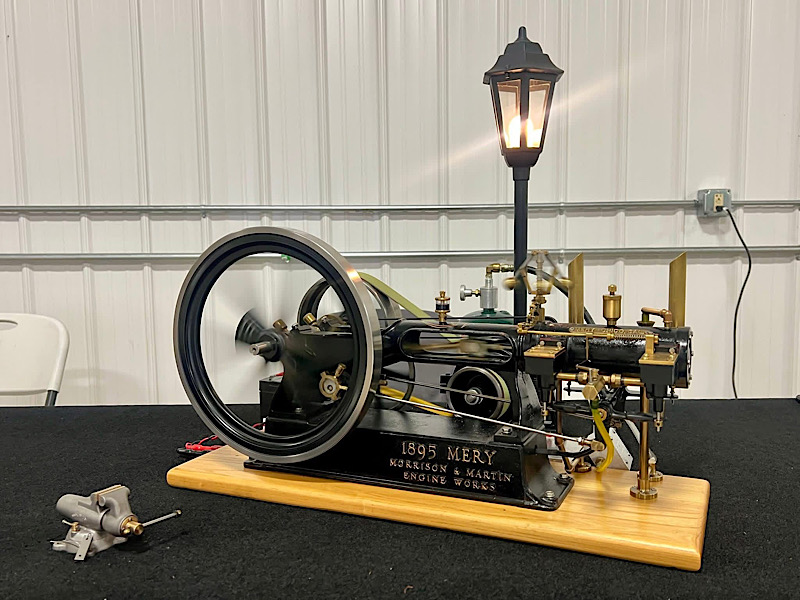
Hassellbear, that is a beautiful engine, and I wouldn't mind finding one like it someday!
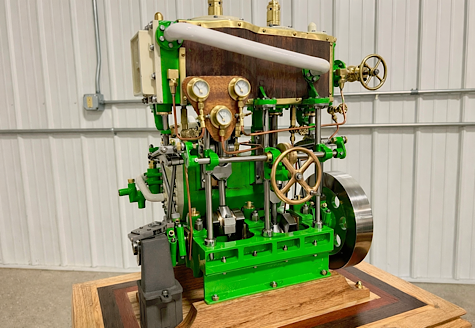
The problem with the wobble is not unusual for engines that have the flywheel mounted to a cantilevered crank end. This is not an ideal design, especially with the flywheel located right out at the edge of the base where it could be easily bumped or impacted. Here's a similar engine which has a outboard bearing to help support the flywheel:
[ Guests cannot view attachments ]
As far as fixing, I don't think I would want to try straightening the shaft while still mounted in it's bearings. What I would recommend, if you have a lathe, is mount the unbent end in the headstock, preferably in a collet. An auxiliary support bearing could then be attached to the carriage to support the outboard bearing journal. I would use a split bearing arrangement, whereby it could be tightened down with bolt to secure the shaft.
This arrangement allows you to rotate the crankshaft in the lathe, by hand, until the bent end faces up. A magnetic-based test indicator could be mounted on the carriage to check the degree of runout. Light tapping with a brass hammer should bring it back to straightness. It's not really bent very much. The amount of the bend is exaggerated by the large diameter flywheel. When the test indicator reads essentially zero as the crank is rotated, you're finished.
The above operation could be accomplished with the crank remaining in the engine, but it may end up damaging the outboard bearing. Also, "Woe is me" makes a very good point about disassembling the engine. Make sure every part is identified as to it's exact position, so that everything will work smoothly when reassembled.
Paula


 Home
Home Search
 Today's Posts
 Login
Login Register