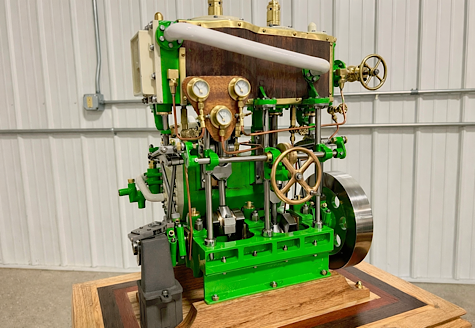
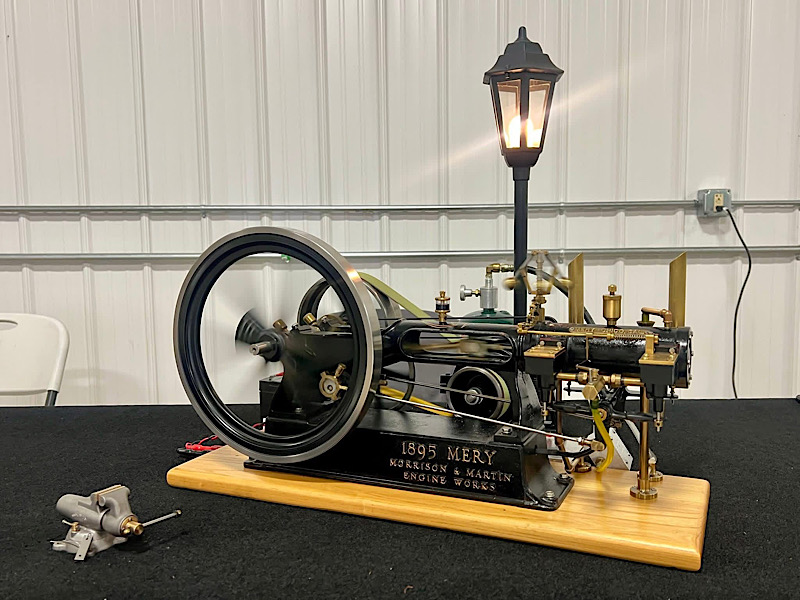
Hello folks. The thing to think of when mounting any engine, anywhere, from hanging one on minimal aircraft structures to more traditional bedding, is the flywheel/crankshaft assembly is what you’re trying to control. Piston direction doesn’t make much difference. The stutter of a single cylinder engine can be thought of as fairly violent slowing and speeding up, repeated with each firing stroke. The crank is trying to twist the rest of it, then slows suddenly, reversing the twist.
Our goal is to put the centerline of the crank as low and as close to the middle of the structure it’s attached to, in order to counteract that stutter. A mount of any kind is almost like handlebars on a bicycle, or a post hole digger. So your goal is to make the imaginary triangle from the center of the shaft to the far corners of the base where it contacts the ground or table a short, wide, relatively centered “handlebars” that damp out the stutter. The crank is always the center of rotation.
Think about in-line or V car engine motor mounts. The two main mounts are as close as possible to the level of the crankshaft, and as widely spaced as the structure allows, regardless of the orientation of the cylinders above.


 Home
Home Search
 Today's Posts
 Login
Login Register