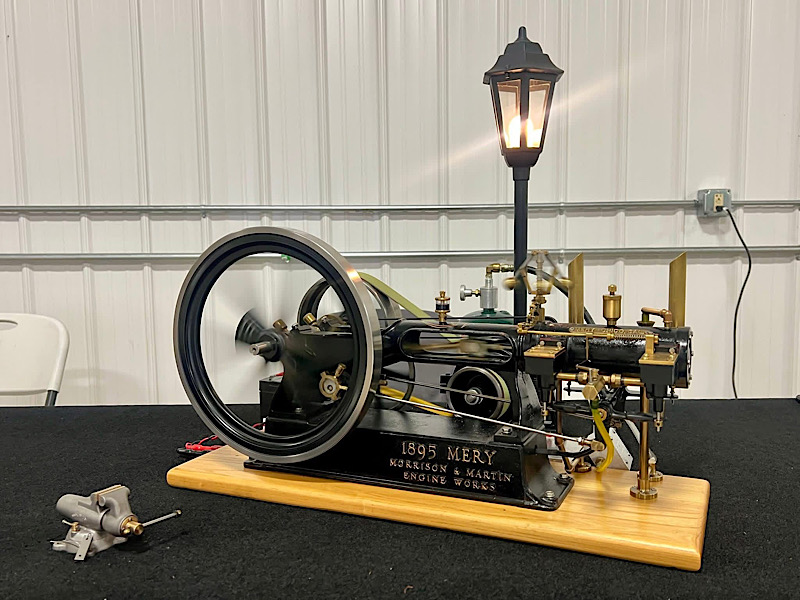
As requested, here's a detailed description of the Schoenner gas engine cycle provided in Wayne Grenning's excellent book: Flame Ignition, A Historical Account of Flame Ignition in the Internal Combustion Engine, p. 167, paraphrased here: After lighting the burner and with the piston at top dead center, the flywheel is rotated. As the piston moves toward the flywheel, a cam on the end of the side-shaft depresses (opens) a poppet valve at approximately 45 degrees of rotation. Immediately afterwards, another poppet valve opposite the ignition port momentarily opens to allow fuel to enter the cylinder. At about fifty percent stroke the piston passes the ignition port and flame is drawn into the cylinder where it ignites the air-fuel mixture. Both fuel and air valves are closed at this time. Combustion pushes the piston to bottom dead center. On the return stroke, exhaust gasses pass through the same valve that allowed air to enter the cylinder and the cycle repeats itself at top dead center. This arrangement was patented in the UK and US in 1894 and 1895, respectively.