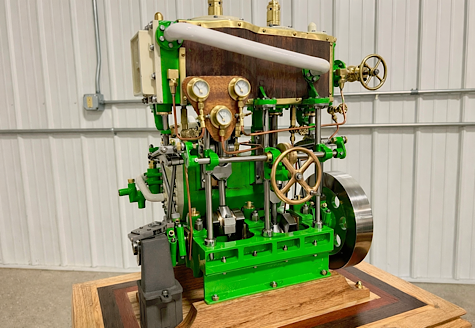
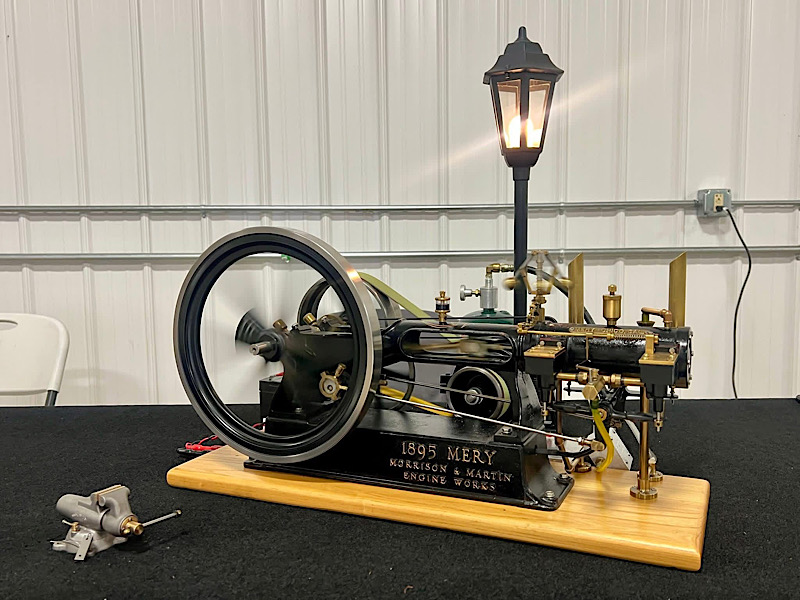
Picked up my 4 lost sheep (QX-6) at the post office....my flock is Growing! [ Guests cannot view attachments ]
Aahhh....the Sterling buying force is strong with this one Master.
My Midi-chlorians have been pulling double shift complicated by steam-bug venom that has now also mutated to Sterling venom....things could go crazy wrong at any moment....Lol!
Aahhh....the Sterling buying force is strong with this one Master.
My Midi-chlorians have been pulling double shift complicated by steam-bug venom that has now also mutated to Sterling venom....things could go crazy wrong at any moment....Lol!
you May be spiraling down the model collecting suction hole of no return....but your not alone
Aahhh....the Sterling buying force is strong with this one Master.
My Midi-chlorians have been pulling double shift complicated by steam-bug venom that has now also mutated to Sterling venom....things could go crazy wrong at any moment....Lol!
you May be spiraling down the model collecting suction hole of no return....but your not alone

Misery Loves company!
Here we have a go at production "Henry Ford" style.
[ Guests cannot view attachments ]
Well, I am up to a "straight-6", only 2 more engines to build. The board is a rough cut with no edge milled square, I am holding off milling it till I decide configuration and spacing and how long of belts to a transmission.
[ Guests cannot view attachments ]
I believe this is the configuration Bruce suggested and it does offer smaller footprint. I have not decided yet. [ Guests cannot view attachments ]
The issue I see with them facing each other is the rotation will be opposite , is there a way to Change that on these engines ? To get past this you could always do a figure 8 on the belting on one flank.
Edit: I did just envision a line shaft elevated directly over the axles of the engines , with extra pulleys to run accessories , I think Wilesco has some taller ones that may do nicely.
I believe I have 3 options...First I could run one bank conventional belt then run other bank with a cross belt so there all pulling the same way, the X in the belt of course reversing direction.
Option 2 would be to Ream a new crank pin hole in the flywheel or the displaced side to change timing.
Option 3 would be to replace the dowl pin flywheel axle...right now it has 2 flats ground at 90 deg from each other...I was thinking of grinding 2 ring grooves where the set screws bear on the pin or just use a harden pin and play with different timing! My Peanut Rider does not have 90 degree timing...more like 100 degrees so I wanted to see if there was a timing setting that offers say....more speed or more power. 90 degrees may well be the best...but I like to find out for my self....on that note I am going to go try different timing on my modified unit....be back soon!!!
I believe I have 3 options...First I could run one bank conventional belt then run other bank with a cross belt so there all pulling the same way, the X in the belt of course reversing direction.
Option 2 would be to Ream a new crank pin hole in the flywheel or the displaced side to change timing.
Option 3 would be to replace the fowl pin flywheel axle...right now it has 2 flats ground at 90 deg from each other...I was thinking of grinding 2 grooves where the set screws bear on the pin or just use a harden pin and play with different timing! My Peanut Rider does not have 90 degree timing...more like 100 degrees so I wanted to see if there was a timing setting that offers say....more speed or more power. 90 degrees may well be the best...but I like to find out for my self....I that note I am going to go try different timing on my modified unit....be back soon!!!
This will be interesting , looking forward to what you decide to do.
How cool is that seeing them all lined up??
Well, THAT was easy. I just took the flywheel side and loosed the set screw and rotated flywheel 180 deg without letting the displaced side move. In stock configuration with set screws bearing on flats pre-cut the top of flywheel runs in the direction of the power piston or "running over" if I have my terminology correct? By simply moving The flywheel 180 deg she now runs backwards or "running under"...took right off first try!
I am not bearing (set screw) on a flat right now but with no load its fine for temporary test. I am not worried about the set screw raising a burr as pin is hard.
Easy as pie!...the simplicity of these engines is refreshing...next will be performance timing test...or....how bad can I mess up the timing and still run, lol!
Did some non precious timing tests...to try to simplify this you can think of the flywheel assembly like a transparent clock, there is a crank pin on the "pulley" side and one on the big "flywheel" side. Viewing the "clock" from Flywheel side rotate engine till pulley pin is at 12 o'clock, flywheel pin will be at 9 o'clock in stock configuration and the flywheel will run clockwise.
Now stop engine and rotate pulley pin back to 12 o'clock and loosen flywheel set screw and while keeping pulley pin at 12 o'clock rotate loose flywheel pin to 3 o'clock and tighten set screw...engine will now run counter clockwise.
Rough experiments show you can change timing about plus or minus about 5 minutes so one way it will run between 2 and 4 o'clock and the other way between 8 and 10 o'clock. Both 9 and 3 o'clock "seem" close to optimum but I had to many variables to make determination on that (just yet)
I did run into some snags that was all part of the fun learning....my engine started to run poorly even at optimum settings and my first thought was I may have contaminated the power piston with oil as I have over oiled this engine and with all the adjustment my fingers where wet with oil....the other thing that happened is during all the timing experiments I had left the burner running while engine stopped (for extended time)and without the air constantly circulate inside the Engine the base was getting really hot. As an experiment I had a glass of drinking water at my work bench and I dip paper towel in my water and sponge down the outer power piston cyl and also the cooling fins and also the metal base and Bingo! I had my Nice running engine back!! So generally the hotter flame gives more speed BUT if the engine is not running internal air by those cooling fins the entire engine can get so warm it will fail to run, the power piston side Must remain much cooler to have a good running Stirling engine. Lesson learned!
I will do more experiments but getting late here...just super happy the engine IS reversible!
Stirling are extremely simple engines, which as long as mechanics are sound, solely rely on a certain amount of temperature difference, to obtain the expansion/contraction of air needed.
When the entire construction is more evenly heated that phenomen is reduced, which often is seen in poorly designed homebuilds with insufficient cooling.
Once "overheated" the sole solution is to let it cool, to get it back to full efficiency...or simply apply more heat to the heat cap.
On a model like this, adding more heat would most likely cause serious issues, as several parts on there only tolerate a certain amount of heat.
I reversed my Peanut Rider the same way shortly after it arrived just to see if it worked.