-
Restoration of a Mason Steam Car Engine - Part 3 (last)
Posted by
Gregowen
on 18 Apr, 2021 19:34
-
First, thanks very much for the comments and compliments from our esteemed Moderators, on parts 1-2!
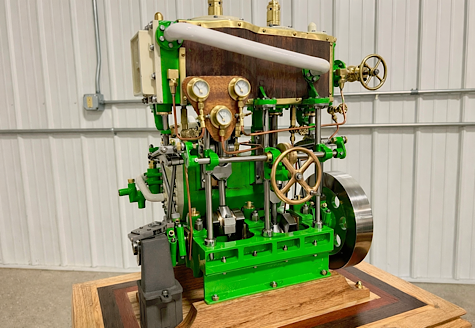
This final group of photos shows various views of the finished engine. As reassembly progressed, it soon became obvious that the engine did not have anywhere even close to the level of smooth and free movement required for it to actually function, especially slowly for demonstration purposes, at relatively low PSI.
But, I was already prepared with a "Plan B": Since the engine would not be running, I opted to replace both the single broken cylinder head cap and the (intact) valve chest cover with 1/4 inch plexiglass sheet. With these, almost all of the hidden moving parts of the engine would be visible, like a museum display (with the entire engine mounted on a mahogany base). The only part that was left entirely original and untouched is the brass exhaust pipe that exits below the cylinder block (something had to be left all-original!).
I was a bit disappointed that my goal of making it run did not bear fruit, but overall was very happy with how it turned out, regardless. I spent an average of about one hour a day on the project, over about four months in 2018. It may no longer be powering a car, but I believe that it would be hard to find a more attractive Mason #1 engine anywhere, and I certainly enjoyed the process. The whole thing weighs about 55 pounds, and is easy to move.
Thanks for looking, and of course any questions or comments welcome! - Greg
[ Guests cannot view attachments ]
[ Guests cannot view attachments ]
[ Guests cannot view attachments ]
[ Guests cannot view attachments ]
[ Guests cannot view attachments ]
[ Guests cannot view attachments ]
[ Guests cannot view attachments ]
-
-
#1 Reply
Posted by
Stoker
on 18 Apr, 2021 20:01
-
Sorry it didn't turn out at the operational level you were hoping for, but I gotta say that it is officially "Pretty Dang Cool" and definitely very attractive the way that it did turn out. Nicely done!!!
Any chance you can back feed power through it with an electric motor, or even a hand crank, to make it go through its motions in a demonstrative manner?
-
-
#2 Reply
Posted by
Gregowen
on 18 Apr, 2021 22:03
-
Thanks for the compliments Stoker, as for the idea of getting it to cycle for demonstrations.....well, I can't see any practical way of using a motor, or even getting it to turn easily by hand, as it sits....
Actually, it WOULD turn fairly easily by hand for demonstrations, except for one problem. Since I was doing my best to restore it to some sort of running order, I assembled it using the correct graphite cord packing needed to seal the piston rods and the valve eccentric rods. That required installing the cord under pressure, in effect, with the pressure applied by the threaded brass "collars" there. That is the way it was made to work, but for this one, that packing just adds even more friction on top of an already imperfect engine. As it is, it will turn over, but requires using both hands applied to both sides of the crankshaft (with plenty of force). To change that, I would probably need to take most of it apart again (including the dreaded ball bearings). Then, it would turn far easier, but would also create a substantial pinching hazard (lots of ways to get fingers caught in this thing). So, for now it stays as it is (probably forever, as long as I have it)!
I wish I had a time machine to travel back to 1902, the guys who originally put them together at the Mason factory could fix it all quick. As I worked on this engine, it became obvious that these engines were probably made as much in the tradition of a "blacksmith" shop as by "machinists". I am guessing that the component parts were made and assembled in such a way that some fit with others, and some did not, and the builders had to develop skills to quickly determine which parts from the various bins would, together, make a working engine.
I will follow up soon with one last photo - showing all the bits that were left over when I was done (including the graphite cord). Cheers - G
-
-
#3 Reply
Posted by
Jim
on 19 Apr, 2021 00:32
-
Really enjoyed this three part series, thank you.
-
-
#4 Reply
Posted by
Stoker
on 19 Apr, 2021 00:33
-
Anyway you look at it, that is one beautiful piece of historically significant mechanical art, that anyone would be proud to displace in a place of honor!!!
-
-
#5 Reply
Posted by
classixs
on 19 Apr, 2021 03:26
-
Sorry to hear that it wasnīt possible to make it run as intended, but agree with the above.
Itīs a very interesting piece of history, that turned out as an amazing display engine.
With what you had to work with there, iīd say VERY well done!
-
-
#6 Reply
Posted by
Gregowen
on 19 Apr, 2021 19:24
-
Thanks to all for your compliments, I am honored.
I have collected many steam engines over the years, and they were all models, but eventually I guess many people get the urge to have an authentic antique engine that was actually used back in the day. I have only this one, and my unusual "spitjack engine", and that is probably as far as it will go. Most genuine period-used engines are of course just far too big (and/or expensive).
Here I share two more photos, one of the unused bits that were left over (both original, and the parts that never got used - including some of the graphite packing cord). The other is a diagrammatic plan showing all the many parts of an entire steam car engine plant. The engine is located at the far lower right (white rectangle), and compared to the complexity of the rest of the system, it almost seems insignificant!
Thanks again - G
[ Guests cannot view attachments ]
[ Guests cannot view attachments ]
-
-
#7 Reply
Posted by
jjtjr
on 16 Jan, 2022 08:08
-
Just joined this group. I have a mason engine model c. Which is in a locomobile steam car. It looks the same as your engine except it uses all ball bearings even the cross head slides. My question is did you replace the rings. Ive been driving the car for sometime now and need new rings, getting blow-by on both cylinders, the engine will no longer run. Looking for a source for them, or else i will have to machine them.
-
-
#8 Reply
Posted by
jjtjr
on 23 Jan, 2022 06:52
-
-
-
#9 Reply
Posted by
Gregowen
on 02 Feb, 2022 18:37
-
Hi JJTJR, I just now saw your posts. No I never replaced the rings, of course I gave up on any hope of making it run before I finished, but the rings seemed to me to be in good shape, fitting well into the bore, not loose. Of course I had no reference to really know either way. Looks like a great project you have there, could you post some photos of the entire car? Thanks - Greg
-
-
#10 Reply
Posted by
Gregowen
on 02 Feb, 2022 20:42
-
Forgot to add, and some photos of the engine? Very curious to see what it looks like. Great videos! Thanks - Greg
-
-
#11 Reply
Posted by
jjtjr
on 03 Feb, 2022 06:29
-
Here is the car. You have the perfect engine to put into a car.
-
-
#12 Reply
Posted by
Gregowen
on 03 Feb, 2022 12:39
-
Beautiful car and engine, Thanks!
-
-
#13 Reply
Posted by
jjtjr
on 06 Feb, 2022 07:11
-
I was having a problem with the mason. made progress yesterday on my 1901 model C mason, I was able to remove the piston from the cylinder. The problem was that I could not unscrew the connecting rod from the crosshead. I loosened the piston rod assembly nut, but it would not unscrew. After a very close look, I found a pin going thru the crosshead rod. I drove the pinout and then was able to unscrew it. My question is why to use a pin when you have a locking nut. My last mason 1899 did not have this pin just a locking nut.
-