This was my first attempt at an iron pour, and I learned lessons #5 (don't pour iron into petrobond, although some folks successfully do this), and lesson #6, don't open the mold soon after pouring iron into it, because a cloud of smoke will rise up out of the sand, and will combust, and burn all the hair off of your face, and potentially blind you.
I was not wearing a face mask when I broke this mold open, since I assumed the dangerous part was over, and so I was met with a ball of fire in the face.
I saw it coming, and closed my eyes, but burned off some of my eyebrows.
My wife yelled "What the heck just happen? Where did all that smoke come from?".
"Just a minor scratch" I yelled back (I always say that regardless of the injury; its a marital thing).
The petrobond began to fail as the iron filled the mold, and so I had some sand inclusions in the rim.
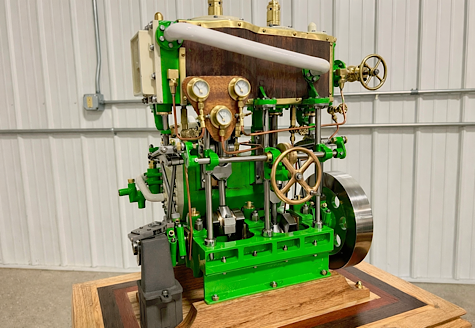
I did not know if I would ever succeed with another iron casting, so I decided to repair the flywheel and use it, and it is the flywheel that is seen in my final green twin oscillator engine photo. I turned the flywheel to hide the repair, and the repair did not affect the flywheel structurally.
So I succeeded with my first attempt at an iron casting, and not because I understood how to cast gray iron, but more through luck and chance.
Casting gray iron involves some procedures that are not necessary with aluminum, and so it can be tricky to cast if you are not aware of exactly what to do, and when to do it.
Luckily the casting turned out to be easily machinable with no hard spots, in spite of me not using ferrosilicon additive, which I was not aware of at the time.
For iron castings that are thinner than this piece, using ferrosilicon is a must to prevent the iron from becoming very hard like tool steel.
So I lucked out and got a usable iron casting on the first try.