Well I did a little close up investigation, and re measured OD of the hub and ID of the follower, and discovered that within the measuring capability of my calipers, ID and OD are identical. Couldn't have achieved that if I'd tried for it. I can get a 2 thou feeler gauge in this gap, and freely rotate the hub.

So I gave the follower a polish on the ID, and the hub a polish on the OD, and after that they go together nicely and the hub rotates freely in the follower. Sort of disappointed, but polishing those two diameters to a better finish is not a bad thing anyway I guess.


The photos tend to exaggerate surface roughness, but even so I could have done better on the face of the hub with the offset boss on it. Should have done a skim after making the offset boss. Live and learn.
After that, I didn't make any new parts, but spent the day reorganizing the shoppe to better arrange tools. I made a Version 3 roly thing:

It's just one of those cheapy wire carts, but with solid infills on all 3 shelves, and anti slip mats on the lower 2. Top one deliberately has no lip. Also added a backboard out of some scrap polypropylene sheet that was thrown out from work years ago. This serves as a clip board for prints and a white board for notes as needed. This is so any metrology tools don't sit on the top with other tools and bits of material, where they have a habit of working their way towards edges. Middle one is for said metrology tools, so that they can't be knocked off during normal use. Top is for whatever selection of tools I need for whatever I'm doing. Lower one actually now has my gauge pins on it for ready access. Quickly thrown together though this is, it's rather handy.
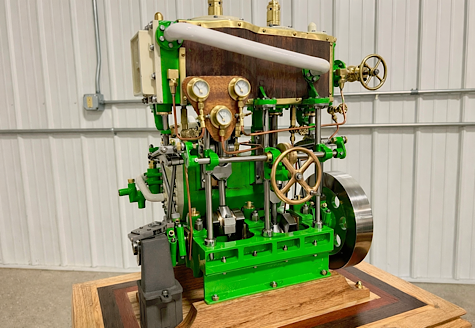
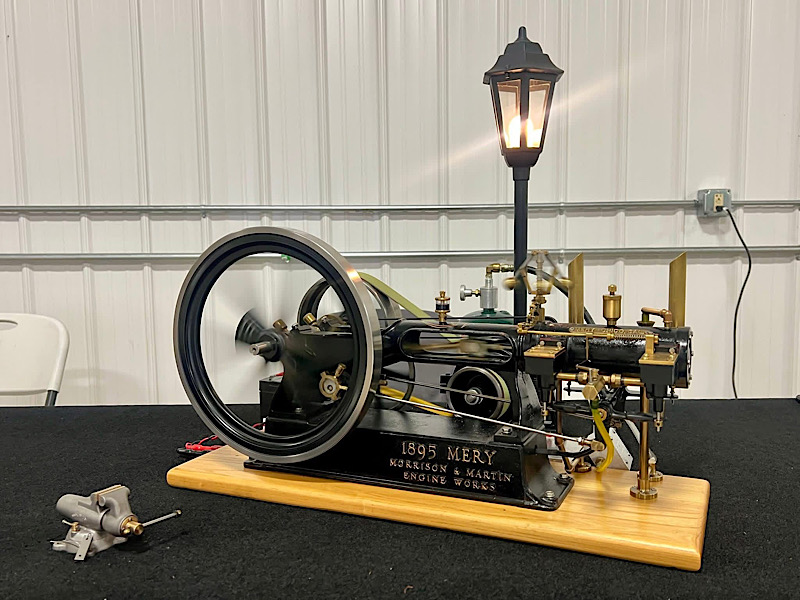
And then I allowed myself a look at the next engine project, for inspiration.

Mounted my collet chuck back on the lathe, and worked on the crankshaft. Even got to use my recently made carriage stop, which was hugely satisfying.

Not great finishes.

Went to test it in the base casting - fits lovely - nicely held between the journals, and it spins a treat. Not too much play, spins freely. I am exceedingly happy with this.

Now I have to mill out the center support web and turn the big end journal. I am frankly nervous that the crank will move all over the place when I mill out the support, but if it does I'll just make a built crankshaft. I had considered making a support jig, and taking out the support bridge before doing any turning - but I've read some success stories with this approach, so I just went for it.
If it doesn't move too much when I take out the bridge, then I'll make a jig to hold it and turn that center journal.
I had what I thought was a rock solid plan for finishing the crankshaft, so to that end, I popped it in the mill, to find center of the shafts, and spot the .75" offset for the crank diameter turning. Which worked great.

Small ER11 collets and a holder are jolly handy to have around for clearance issues.

A little jumping around. I decided to clean the outside of the webs to a radius while I still had the collet chuck set up.

Then cleaned the underside and removed the bridge.

I haven't been able to bring myself to check whether the thing has moved around yet.
But anyway - went to install in the 4 jaw, thinking I could hold on to one crank web and indicate the spot mark. But no go - the one shaft going into the chuck interferes with the chuck body, and I can't get it positioned right. So, I may have to make the jig that PM Research have in their plans after all.
But I didn't feel like doing that right now, so I decided to make the piston. A failry simple part really, just needing diligence on turning the diameter.
I turned diameter, then made a "sacrificial groove" on the end face, to check depth of the grooving tool, and set up the dial. Then made the grooves. This carbide grooving tool is really, really nice.

I set up a DTI to more accurately measure saddle movement.

This works so well, that I am clearly going to have to make a proper holder for it and use it routinely. Cheaper than a DRO, although more faffing about.
After grooving for a while, I cleaned up the face and drilled the 1/8" through hole. I wanted to do this in one set up, because it is important that the hole is very perpendicular to this face, as this is what locates the cylinder shaft - although really it's just the face that does that.

Parting is such sweet sorrow.
This was the best parting op I have ever done. The parted face ended up with a good surface finish. I could have parted to length - and probably will next time. First time using this tool.


Then flipped it round, faced off the little bit of clean up stock and counter bored the other side per print.


That was fun. Interesting change in surface finish on the face of the part in the last picture. Can't feel it with a fingernail - it's just from when I turned the coolant on part way through facing it. Lesson learned - perfectly fine, just looks weird. I can polish it out, but since it will be hidden in the cylinder I'm going to leave it as is.


 Home
Home Search
 Today's Posts
 Login
Login Register